 Schedule a Visit

13 Essential Questions to Ask When Buying an Engagement Ring (2026 Guide)
February 17th, 2026
Average Reading Time: 11.5 minutes
Your engagement ring is one of the most important purchases you will ever make. Your spouse will wear it on her left hand every day for the rest of their life. It's a beautiful and deeply meaningful symbol of the love you share. Every engagement ring is unique. While some may wear the same kind of ring, each one has its own meaning, significance, and importance to the wearer. As every marriage is special and beautiful, so too is the ring worn to symbolize it.
Designers make a nearly infinite variety of engagement rings, each exhibiting its own distinctive style and characteristics. With so many to choose from, expressing one’s individuality and personality is easy. Yet, it also can make it challenging to find one that suits you and your soon-to-be spouse’s lifestyle, budget, and tastes.
That’s why it’s so important to let a jeweler help. They have the knowledge and expertise to ensure you find a ring that speaks to you. With training and experience, only a professional can guide you through everything a jewelry store offers. To make the best use of your and their time, think carefully about what questions to ask when buying an engagement ring. It will help you think about your wishes when searching for a ring and the extent to which they can help.
These 13 questions are vital to understanding what you are looking for and how to find it when buying an engagement ring. When you go to the Wedding Ring Shop, be prepared to ask these engagement ring questions.
In this article we are going to discuss:
- Questions to Ask Yourself (Before Shopping)
- What's My Budget
- What's My Partner's Style?
- What Ring Size do I Need?
- What's the Timeline?
- Natural Diamond, Lab-Grown, or Alternative Gemstone?
- Questions to Ask the Jewelers (At the Store)
- Can I see the Diamond Grading Certificate?
- What are the Four C's?
- How is this Ring Constructed?
- What Metal Do You Recommend for my Lifestyle?
- Can This Ring be Resized?
- Do You Offer Customization or Engraving?
- What's Your Warranty and Return Policy?
- Do You Provide an Appraisal for Insurance?
- Bonus Questions

Questions to Ask Yourself (Before Shopping)
Before even going to the jewelery store, consider these tips on how to buy an engagement ring with questions to ask yourself before you start shopping. Our engagement ring buying guide focuses on determining what you want first, then going to the jewelry store to find the ring you want.
1) What's My Budget?
Buy a ring that you are comfortable with affording. There has been a long standing idea that you have to spend three months of your gross income on your enggement ring. There is no true statistical or romantic requirement on what that number is. We recommend prioritizing a budget that allows you to start your marriage off with a ring you can afford rather than hitting a specific salary-based milestone.
The average spend in the U.S. hovers around $5,500 to $6,500, but will vary depnding on what you prioritize in your ring. Metal type and your center stone will fluctuate your rings cost.
One of biggest factors in your ring's cost will be lab grown versus natural diamonds.
In 2026, a 1.0 Carat (Round, VS1, F color) can range:
- Natural: ~$4,000 - $5,500
- Lab-Grown: ~$700-$900
While lab grown diamonds can be lower in overall cost, natural diamonds hold more of their value for resale.
Regardless of what you decide, this is a decision you should make before you begin shopping. Once you know your budget, this will help you immediately rule certain rings out of the running as you narrow your search down to only the ones in your price range. By keeping the jeweler aware of your budget, they will better be able to help you find an engagement ring you can buy without regret.
2) What's My Partner's Style?
Once you've settled a budget, this is the next most important question on your list. Engagement rings come in an enormous variety of styles. Some are large, some are small, some are gold, some are platinum, and most have diamonds, although there are some that use other stones. The list goes on. Knowing what styles you are looking for ensures that your jeweler knows what rings you and your future fiance will love.
If the two of you are going ring shopping together, you will have a much easier time with this question. While this was once an unheard-of practice, it's now becoming more common. Today, it's perfectly acceptable for couples to ring shop together.
However, if you're determined to have the element of surprise in your proposal, your job will be a bit harder. Here are some quick tips to research secretly:
- Pay attention: Keep your ears open for anything she may mention in passing about rings and jewelry.
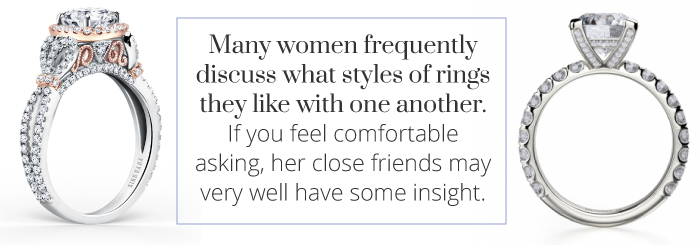
- Ask her friends: Many women frequently discuss what styles of rings they like. If you feel comfortable asking, her close friends may very well have some insight.
- Browse her social media: Plenty of women use websites like Pinterest as a place to compile ideas for their future weddings. While you may not be able to find the exact ring she likes, you might be able to get a feel for the styles she prefers. Note that not all ideas are as direct as you would like them to be. They could just be “floral patterns” or “vintage looks.”
- Look at what she wears now: Does she love to dress up and wear delicate, fine jewelry? Does she frequently wear things that evoke a more vintage, old-fashioned vibe? Does she only ever wear very minimalist jewelry? Or does she have a bold, expressive sense of style? By taking her everyday style into account, you might be able to get some clues about her ring preferences.
- Consider her occupation: If she has an outdoor, active job where fancy jewelry would be impractical, you might want to opt for a simple design. On the other hand, if she works in an office, you probably have the license to go for something a little flashier.
- Ask the expert stylists at The Wedding Ring Shop, the premier jewelry store of Honolulu, Hawaii: Our staff members train with experts straight from Hearts On Fire, TACORI, A.JAFFE, Michael M, and many other designers that we carry. Tell us more about your beloved, and we will be sure to help you find something she will love! If you still cannot decide, a temporary mounting is a great solution; you can pick out the perfect loose diamond from our Diamond Bar and purchase a temporary mounting (a plain gold or platinum engagement ring). We will temporarily set the diamond into the mounting for your surprise proposal, and when the two of you are ready, you can come to The Wedding Ring Shop together and pick out a ring in her desired style. Plus, when you return your temporary mounting, you'll get full credit toward your engagement ring purchase!
Most people will fall under one of these three aesthetic choices: Classic, Modern, and Vintage.
- Classic: includes solitaires, round or oval stones, and simple prong settings. Fits a more timeless and elegant vibe that doesn't go out of style.
- Modern: includes bezel settings, thick "chunky" gold bands, east-west stones. Fits a bold, fashion-forward vibe.
- Vintage: includes milgrain, filigree, art deco. Fits a romantic, detailed vibe. Feels more like an heirloom.
When picking a metal type for an engagement ring, use daily jewelry your significant other wears to clue you in on what metal they are most comfortable with. Be sure to factor in your partner's daily lifestyle. For example, a partner who is in a more "hands-on" workplace (nurses, chefs, athletes), may want to avoid a high profile prong that can snag on gloves or sweaters.
The "Hands-On" Partner: (Nurses, chefs, athletes)
- Avoid: High-profile prongs that snag on gloves or sweaters.
- Choose: Bezel settings or Low-profile settings where the diamond sits flush to the finger.
The Minimalist: (Doesn't usually wear much jewelry).
- Avoid: Heavy "halo" settings or wide bands.
- Choose: A thin Solitaire band (1.5mm–1.8mm).
The "Extra" Partner: (Loves fashion and "the more sparkle the better").
- Choose: Hidden halos, Pavé bands, or Multi-stone (Trilogy) rings.
3) What Ring Size do I Need?
This isn't a top priority for planning purposes, but it's still crucial to know when you get down to the fine details of ring buying. Again, this won't be a problem if your significant other is coming with you to go shopping. Jewelers are experts at ring sizes. However, if you're trying to surprise her, you'll have to do some detective work.
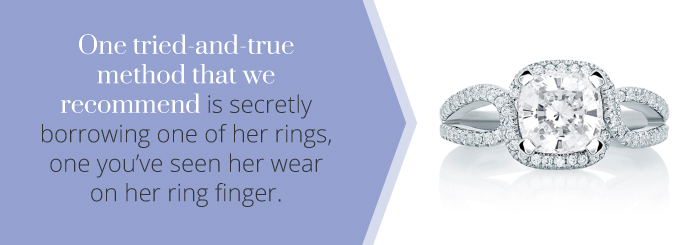
You could try asking her friends or family, although not many friends will know this about one another. Many women don't even know their ring size. One tried-and-true method we recommend is secretly borrowing one of her rings, one you've seen her wear on her ring finger. It helps if it's one she doesn't often wear, so she might not notice it's missing. Our trained staff can measure the size of the ring with our special tools. Remember to put her ring back where you found it when you're done!
For reference here are some common sizes by region:
- United States: Size 6 to 6.5
- United Kingdom: Size L to N
- Europe: Size 52 to 54
- Asia: Size 9 to 11
Of course, even if you buy the ring and it turns out to be the wrong size, it isn't the end of the world. Our in-house jeweler and our designer partners can resize rings; however, note that resizing can be tricky when dealing with diamonds along the band, so be sure to speak to a Wedding Ring Shop consultant when making your purchase.
4) What's the Timeline?
This might seem unrelated, but it's an important thing to decide. The reason for this is that some rings are available to be bought right on the spot. Some need to be ordered and will take time to arrive. Others might need to be custom-made, especially if the ring size is exceptionally small or large. Engraving will also take some time; should you wish to engrave a personalized message. Our team is dedicated to keeping you up to date with the status of your ring, and is here to give you proposal ideas!
If you know you're going to propose in two weeks, it might be best to avoid selecting a custom ring that will take six to eight weeks to make. Always keep your jeweler in the know. Many jewelers can try to help with rush order possibilities.
When deciding on what the best time to buy your ring, consider these buying seasons for engagement rings:
- Slow and Specialized (January-March): Post-holiday, it is typically less crowded, perfect for more one-on-one attention.
- Summer Value Windows (July-August): Historically the "cheapest" tiime to buy.
- Black Friday Peak (November): Most aggresive site-wide discounts for many jewelers.
5) Natural Diamond, Lab-Grown, or Alternative Gemstone?
One of the biggest differences between the three is price. Natural diamonds carry the higher price tag, while lab-grown is substantially cheaper, while alternative gemstones can vary widely based on the gemstone.
Natural diamonds will offer the "brilliance" and "scintillation" carrying a deep, crisp look you can only get from a diamond. All gemstones have a sparkle, but each sparkle differs slightly. A gemstone like sapphire has a more "velvety" luster.
The environmental impact of natural, lab-grown, and alternative gemstones has moved to the forefront of many making gemstone decisions in 2026. Lab-grown, although resource heavy, many labs now focus more on renewable energy. The mining process of natural diamonds has supported many developing nations with ethical mining being a major highlight of many natural diamond brands today.
For more on why natural vs. lab grown diamonds read our guide on natural versus lab-grown diamonds.
Both natural and lab-grown diamonds are extremely durable and tough. Gemstones like sapphire and emerald will not have the same durability of a diamond, with sapphire showing minor "facet wear" after 20+ years.
Questions to Ask the Jeweler (At the Store)
6) Can I See the Diamond Grading Certificate?
We recommend looking for a diamond grading certification with every diamond.
First you will want to know the major diamond certifications available.
- GIA (Gemological Institute of America): The gold standard. They invented the "4 Cs." Their grading is the most consistent and strictest in the world. Best for Natural Diamonds.
- AGS (American Gem Society): Known for their advanced "Light Performance" metrics. They are top-tier but were recently acquired by GIA to streamline standards.
- IGI (International Gemological Institute): The undisputed leader in Lab-Grown Diamond grading. While they were historically seen as "softer" than GIA on natural stones, they are the most trusted name for high-tech lab gems.
What does a certifiate mean? It means the diamond quality and authenticity has been proven by a verifiable third party.
When reviewing or reading a certificate, look at these four sections:
- The Proportion Diagram: Table % between 54-60% and a Depth % between 59%-62.5%.
- Clarity Plot: Green marks are found on the surface and red marks are inside the stone. Avoid red marks right in the center.
- Fluorescence: In 2026, most aim for None or Faint.
- Inscription Registry: Confirms the diamond has a microscopic laser serial number that matches with the paperwork
If a jeweler tells you they do not have a certificate - walk away. Avoid "In-House" diamond appraisals and jewelers who do not present a certificate.
7) What Are the Four C's?
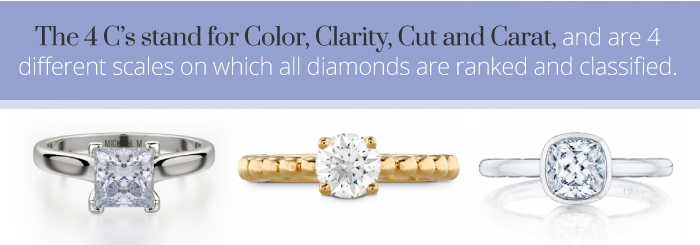
This basic engagement ring terminology will help you be more knowledgeable before you begin shopping. The 4 C's stand for color, clarity, cut, and carat. They are four different scales on which all diamonds are ranked and classified.
By brushing up on these basic terms, you can be better prepared to understand what the jeweler is talking about when they begin to use these terms.
Cut - the "Engine" of sparkle. Cut is often refered as the most important C. It refers to how well the diamond's facet interacts with the light. Only buy "Ideal" (For IGI) or "Excellent" (for GIA).
Color - the "Whiteness" scale. Graded from D (Colorless) to Z (Light Yellow). Most cannot tell the difference between D (to tier) and a G or H (near-colorless) once set on a ring.
Clarity - the "Birthmark" grade. Aim for "Eye-Clean". VS2 and SI1 are ofter refered to as the value kings as they have tiny inclusions that can only be seen under 10x magnification, which means to the naked eye they look perfect. Avoid I1 or I2 as their flaws can affect the diamond's structural integrity.
Carat - The "Weight". Measure of weight (1 carat = 200mg) not the physical dimensions. Prices do tend to skyrocket at "Magic Numbers" (1.0ct, 1.5ct, 2.0ct). Buying a 1.9ct instead of a 2.0ct can save you thousands on a diamond that has virtually no visible size difference.
Which "C" to Prioritize?
If you are working with a fixed budget, follow this hierarchy to ensure the ring looks expensive:
- CUT (Primary): Never compromise here. This creates the "wow" factor.
- CARAT: Most partners have a "size goal." Hit this next.
- COLOR: Go as low as H or I to save money.
- CLARITY: This is the best place to "hide" savings. As long as it’s Eye-Clean, the grade doesn't matter.
8) How is this Ring Constructed?
See with your jeweler if they can breakdown how your ring was constructed and put together. It is important to know you are buying a ring you can rely on in the long run.
Look for rings that you can rely on to maintain its integrity.
When looking at the setting of your center stone, there are two common selections
- Bezel for Maximum Security
- Metal rim surrounds the entire perimeter of the diamond, protecting from chipping and most secure for active lifestyles
- Prongs for Maximum Sparkle
- Small metal claws hold the stone allowing for more light.
- 4 Prongs - Makes diamond look "squarer", but if one prong fails, the stone is likely to fall out
- 6 Prongs - The "Tiffany" style, makes the diamond look rounder and offers a larger safety net
- Small metal claws hold the stone allowing for more light.
2026's biggest band trend is the "Ultra-Thin" band.
- The Danger Zone: Any band thinner than 1.5mm is prone to warping or snapping
- The Sweet Spot: A 1.8mm to 2.00mm provides the "thin" aesthetic while keeping its support and strong build
- Depth Matters: A ring needs to be thick, look for at least 1.6mm in height to prevent the ring from cracking at the bottom
When looking at a ring in person, use a jeweler's loupe (magnifying glass) to check for symmetry, the "gallery" and the ring from the side and the finish.
Major "tells" in ring production include:
- "Hollow" Band The inside of the ring is scooped out to save metal cost. It will feel light/cheap and trap bacteria/lotion.
- Uneven Prongs Indicates the stone was "forced" into a pre-made setting rather than the setting being built for the stone.
- Snagging Run the ring over a silk cloth or a knit sweater. If it snags, the prongs haven't been polished or seated correctly.
- Thin "Tips" If the prongs look like thin wire rather than solid tabs, they will wear down and break within 1–2 years.
9) What Metal Do You Recommend for My Lifestyle?
In 2026, it is recommended you pick a metal that fits your liefstyle, allergy requirements, and budget. When going for a metal that is made to last, Platinum remains the "king of metals" for those prioritizing longevity. As an added benefit it is also naturally hypoallergenic, and 30 times rarer than gold. While it develops a soft satin finish over time (known as a patina), it never loses its actual volume, making it the most secure choice for holding a center stone. White Gold offers a more accessible price point but a nearly identical icy aesthetic. Because white gold is naturally slightly yellow, it is plated in rhodium for that bright chrome shine, which will wear down every 12 to 18 months and may require "re-dipping" by a jeweler to bring back its color.
For those looking for warmth, Yellow Gold has made a massive resurgence this year, driven by "old money" and vintage-inspired trends. It is naturally lower maintenance than white gold and provides a beautiful contrast to bright white diamonds. Finally, Rose Gold continues to be a favorite for its romantic, blush-toned hue. Created by alloying gold with copper, it is actually the most durable of the gold options—though the copper content means it isn't hypoallergenic, so those with sensitive skin should exercise caution.
Have your jeweler show you the different rings in your preferred metal type to ensure you pick the right ring for your life and lifestyle.
10) Can This Ring Be Resized?
Resizing typically involves a jeweler cutting the band and either adding or removing metal to reach the desired circumference. While malleable metals like gold and platinum are ideal for this, the complexity of the ring’s design—such as side stones or intricate engravings—dictates the limit of how many sizes it can safely move. Most jewelers recommend no more than a two-size adjustment to prevent warping the setting or loosening the stones. For styles that cannot be resized, like full eternity bands or tungsten rings, sizing aids like internal "sizing beads" can be added for a snugger fit without permanent alteration.
Confirm with your jeweler based on the ring you are buying if in the future it can be, if needed, resized. Also confirm what their ring resizing policies are for your future reference!
11) Do You Offer Customization or Engraving?
See with your jeweler if they offer any design options for your ring, whether custom designed from scratch or off the shelf. Determine what areas may be open for engraving, whether the inside or the outside of the ring.
Engraving is one great way to make your ring mean that much more. Custom stones for your ring can also help to make your ring stand out as uniquely their own. See what other personalization ideas or options they may have for you.
Note that any custom work would add time to getting your ring. Be sure to ask what any customization would do to your expected ring delivery.
All custom work also often times increases and affects the price, ask for transparency on what the customization or engraving will do to the cost of your ring.
12) What's Your Warranty and Return Policy?
This is a question that you might rather not think about, but it's still an important one. Sometimes a ring will get damaged, or they want something different. Whatever your reason for needing to return or exchange the ring, it's important to know upfront the jeweler's policy on this. There's nothing worse than realizing you will need to return the ring and then discovering your jeweler has a no-return policy.
Even if you think you will never need it, it is important to be informed about it. Better to know and never need it than vice versa.
Be sure to get clarity on what the warranty covers (whether it only covers repairs or even maintenance) and what the warranty duration is. Ask about what the return window is in the unlikely event you will need to return it and what the exchange policies are in case you need something changed!
Good warranties should cover the full damage and repairs, but often times incur an additional cost to get the covered warranty.
13) Do You Provide an Appraisal for Insurance?
Whether you choose to be conservative or extravagant with your diamond ring, it still represents a significant investment. Aside from the money invested, it also represents a crucial emotional value.
Because of this, it's important to insure your engagement ring right away. To do this, an appraisal will be required to estimate how much the ring is worth. Some jewelers may do this, others may not. It's best to ask to be sure.
Understand the difference between replacement value and actual cash value. Replacement value is recommended in that the insurance pays to replace the ring with a new one of "like kind and quality" where actual cash will pay the "used" value of that ring. Update your appraisal every 2 to 3 years.
Insurance Cost Estimates (2026)
Insurance is surprisingly affordable—usually costing about the price of one nice coffee per month.
| Ring Value | Annual Premium (1–2%) | Monthly Cost |
| $2,500 | $25 – $50 | ~$3.00 |
| $5,500 (Avg) | $55 – $110 | ~$7.00 |
| $10,000 | $100 – $200 | ~$12.50 |
| $20,000 | $200 – $400 | ~$25.00 |
Bonus Questions
What Maintenance Does This Ring Require?
When buying your engagement ring, the jeweler will always know what is best for your specific ring. Ask for cleaning frequency of your ring and see if you can get a professions inspection schedule to help you keep on track with everything your ring needs.
As prongs age, they may tend to lose their grip. Prong tightening may be necessary for your ring during its lifetime, so it is important to see if your jeweler assists with that.
Will this Ring Work with a Wedding Band?
See with your jeweler if the ring you are purchasing has a set that matches it to a wedding band. Matching wedding band options with your engagement ring help to create a single look to your ring. Look for a matching ring that creates a flush-fit with no gap. If you are looking to stack bands over time, consider stacking band options and how your rings will fit within that stack.
Will the Ring Need to be Special Ordered?
Generally speaking, every ring is different. Even at the same jeweler, some rings might be available for immediate purchase. Meanwhile, custom engagement rings and special orders will take some time. If you've done your homework and made your plans ahead of time, you will have a pretty good idea of when you want to propose.
When you find a ring you like, ask how soon you'll be able to take the ring home with you. If the ring you love won't be ready for another two months, you might have to either rearrange your plans or choose a different ring. Either way, this is an important question to ask.
Remember, at The Wedding Ring Shop, you can purchase a temporary mounting to house your chosen diamond for the proposal and then come back together to pick out her dream ring!
What Sizes Do You Carry?
This is on a related note. Many jewelers only carry a standard range of sizes. If the ring size you're shopping for is smaller or larger than any of these standard sizes, the ring will likely have to be custom-made or custom-ordered.
Because of this, it's a good idea to ask about the sizing options for any ring you like right up front, just to be sure.
Can the Ring Be Modified?
An engagement ring is a commitment, so preparing for the future is imperative. No matter how happy you are with the ring today, it's impossible to speak for the future. It's possible that someday, you and your spouse may decide you want to upgrade to something a little bigger and brighter. Maybe you'll want to add more stones, or maybe you want to add more sparkle to your band.
Even if you think this is something you won't be interested in, it's worth noting. That way, when and if that day ever comes, you'll at least be aware of your options available for a possible upgrade down the road.
Is Engraving an Option?
Engraving is a great way to add a personalized, romantic touch. If you're interested in getting something engraved on the inside or outside of your ring band, you will want to ask how it will affect the design. Some jewelers do it, while others do not. If engraving is a must-have for you, it might be best to include this in your research about jewelers before you go shopping.
What are the Payment Options?
Since engagement rings are often such a large purchase, many jewelers offer payment plans so that you do not have to pay the entire sum upfront. However, every jeweler will have a different policy and different rules about this.
If a plan of this nature is something you would be interested in looking into, be sure to include this question on your list.
When visiting the Wedding Ring Shop, be sure to ask your diamond consultant about our special interest and no-interest financing options!
How Do I Clean It?
Engagement rings are built to withstand a lot of wear and tear, but they're not invincible. Especially on the island... humidity, saltwater, sunscreen, and sweat will tarnish any ring if left to its own devices for too long. All jewelry needs to be cleaned regularly to stay as beautiful and pristine as they are on the day you buy them.
Most rings can safely be cleaned at home with a soft baby toothbrush, warm water, and a little soap. Still, it’s worth asking your jeweler if there are any specific instructions for the ring you have chosen. It's also a good idea to ask them if they provide any ring cleaning services since most rings should be cleaned professionally once or twice a year.
When you purchase an engagement ring from The Wedding Ring Shop, you can take advantage of a free professional ring cleaning! The Wedding Ring Shop has recently updated its policy, so now you can visit once a year to get your free inspection and cleaning. Or if you have a special event and need those rings cleaned before, make sure you schedule your appointment!
Time to Start Shopping at The Wedding Ring Shop
By finding out what to ask when buying engagement ring, you can be sure to get the most out of your engagement ring shopping process with these engagement ring shopping tips and engagement ring buying mistakes to avoid at a fine jewelry store like the Wedding Ring Shop. Don't be afraid to write these questions down and use them as a checklist while shopping, especially if it is your first time buying engagement ring. Ring shopping has a lasting impact, so it's worth a little extra time and effort to get it right. For additional tips, check out our engagement ring buying guide.
As you take these steps forward, we hope you will consider us. Our selection of designer brand settings is unmatched. We offer a large variety of cuts and styles as well as plenty of custom options. Not only that, but we're committed to treating you like a member of our family. Ask our experts at any time for the answers to all of your engagement ring questions, or give us a call at (808) 945-7766.
FAQ Section:
Q: What are the most important questions to ask when buying an engagement ring?
A: The top questions include asking about your budget, your partner's style preferences, the diamond's certification (GIA/AGS), the 4Cs (cut, color, clarity, carat), warranty coverage, and whether the ring can be resized. Also inquire about customization options and maintenance requirements.
Q: How much should I spend on an engagement ring?
A: The old "3 months salary" rule is outdated marketing. Spend what's comfortable for your budget, typically between $2,000-$10,000 for most couples. Lab-grown diamonds can reduce costs by 30-40% while maintaining quality.
Q: What questions should I ask a jeweler when buying an engagement ring?
A: Ask to see the diamond grading certificate, inquire about the 4Cs, understand the setting's security, confirm warranty and return policies, verify if resizing is possible, request maintenance requirements, and ensure an appraisal is included for insurance.
Q: Do I need a GIA certificate for an engagement ring?
A: Yes, always request a certificate from GIA, AGS, or IGI. These independent labs provide unbiased quality assessments. A missing certificate is a red flag, as it means you can't verify the diamond's quality claims.
Q: Should I buy a natural or lab-grown diamond?
A: Both are real diamonds with identical physical properties. Lab-grown diamonds cost 30-40% less, are guaranteed conflict-free, and offer better value for larger stones. Natural diamonds have rarity appeal and traditional significance. Choose based on your priorities and budget.
Q: What's the most important of the 4Cs?
A: Cut is the most important C, as it determines sparkle and brilliance. A well-cut diamond will shine more than a larger, poorly-cut one. Prioritize excellent or very good cut grades.
Q: How do I find out my partner's ring size secretly?
A: Borrow one of their existing rings (preferably worn on the ring finger), trace the inside on paper, or have a friend help you get their size. Most jewelers offer free resizing within the first year.
Q: Can all engagement rings be resized?
A: Most can be resized 1-2 sizes up or down, but eternity bands with stones all around can't be resized without affecting the pattern. Ask about resize limitations before purchasing.
Q: What's the difference between white gold and platinum?
A: Platinum is more durable, hypoallergenic, and doesn't require replating, but costs more. White gold is more affordable but needs rhodium replating every 1-2 years to maintain its white finish.
Q: How much does engagement ring insurance cost?
A: Typically 1-2% of the ring's appraised value annually. A $5,000 ring costs about $50-$100/year to insure. Many homeowners/renters policies cover jewelry with a rider.
Q: Should I buy an engagement ring online or in-store?
A: Both have advantages. Online offers better prices and selection; in-store provides hands-on viewing and immediate assistance. Reputable online retailers now offer virtual consultations, free returns, and GIA certificates.
Q: What's a good warranty for an engagement ring?
A: A quality warranty covers manufacturing defects, offers free inspection/cleaning, includes one free resizing, and provides prong tightening for at least one year. Lifetime warranties are ideal.
Q: When should I start shopping for an engagement ring?
A: Begin 2-3 months before your planned proposal. Custom rings take 6-8 weeks; ready-made rings can be sized in 1-2 weeks. Holiday proposals require earlier planning.
Q: What ring setting is most secure for active lifestyles?
A: Bezel settings are most secure as metal surrounds the entire diamond. Cathedral settings with lower profiles and tension settings are also good for active wearers. Avoid high, delicate prongs.
Q: Can I negotiate engagement ring prices?
A: Yes, especially at independent jewelers. Big retailers have less flexibility. Ask about price matching, package deals (ring + wedding band), or seasonal promotions. Lab-grown diamonds have more negotiation room.
Q: What questions should I ask about custom engagement rings?
A: Ask if it's truly custom or modified stock, request CAD designs before production, confirm timeline (typically 6-8 weeks), understand customization costs, verify if final price includes all elements, and ask about design revision limits.
Q: Should the engagement ring and wedding band match?
A: They don't have to match, but they should complement each other. Ask your jeweler to show you wedding band options that pair well with your engagement ring style. Shadow bands are designed to fit together perfectly.
Q: What are red flags when shopping for engagement rings?
A: Warning signs include no diamond certification, extremely low prices compared to competitors, high-pressure sales tactics, vague quality descriptions, no return policy, unclear warranties, and reluctance to show diamonds under magnification.
Q: How do I know if an engagement ring is ethically sourced?
A: Ask for Kimberley Process certification for natural diamonds, inquire about conflict-free guarantees, consider lab-grown diamonds (100% ethical), ask about recycled metals, and check if the jeweler has ethical sourcing policies.
Q: What's the best time to buy an engagement ring?
A: Black Friday, Cyber Monday, and January (after holidays) often have the best sales. However, don't rush quality for a sale. Allow adequate time for customization regardless of season.
About the Author
Michael A. Han is the President and Founder of The Wedding Ring Shop in Honolulu, Hawai‘i. With over 40 years of fine jewelry expertise, Michael has guided the store to become one of Hawaii’s most trusted destinations for engagement rings, wedding bands, and custom diamond jewelry. His passion for craftsmanship and personalized service reflects The Wedding Ring Shop’s core values of quality, integrity, and aloha, helping every couple find a ring that tells their unique love story.