 Schedule a Visit

Engagement Ring Anatomy: Complete Guide to Ring Terminology (2026)
June 12th, 2026
Understanding The Anatomy of a Ring: Why it Matters
Being proposed to with an engagement ring is one of the most important moments in one’s life. You want to make sure you choose the right ring for your significant other, especially since they are made to be worn forever. From the research to the jewelry store visits, finding the right one is a rewarding yet challenging experience. Buying an engagement ring is an adventure, at the Wedding Ring Shop, we do everything we can to make the adventure romantic and unforgettable.
During your shopping journey, it is essential to know all the terms that jewelers, goldsmiths, and gemologists use. This centuries-old art form takes from a large body of knowledge and expertise. Some terms are scientific and technical, while others are more culturally oriented. Check out additional resources online for diamond educations and more on gemstones. Regardless, you should know all of your options when purchasing an engagement ring. This list should inform you of all the terms and definitions jewelers use to define the anatomy of a ring. However, don’t hesitate to call our Honolulu jewelry store to talk more in depth about the parts of an engagement ring that make up your engagement ring.
Here is what we will discuss in this article:
- Diamond Terms
- Diamond Setting Terms
- Engagement Ring Terms
- Precious Meta Terms
- Accent Stone Settings Terms
- Side Stone Terms
- Design Techniques & Details Terms
- Find Your Engagement Ring at the Wedding Ring Shop
- Engagement Ring Terminology FAQ
The Main Components of an Engagement Ring
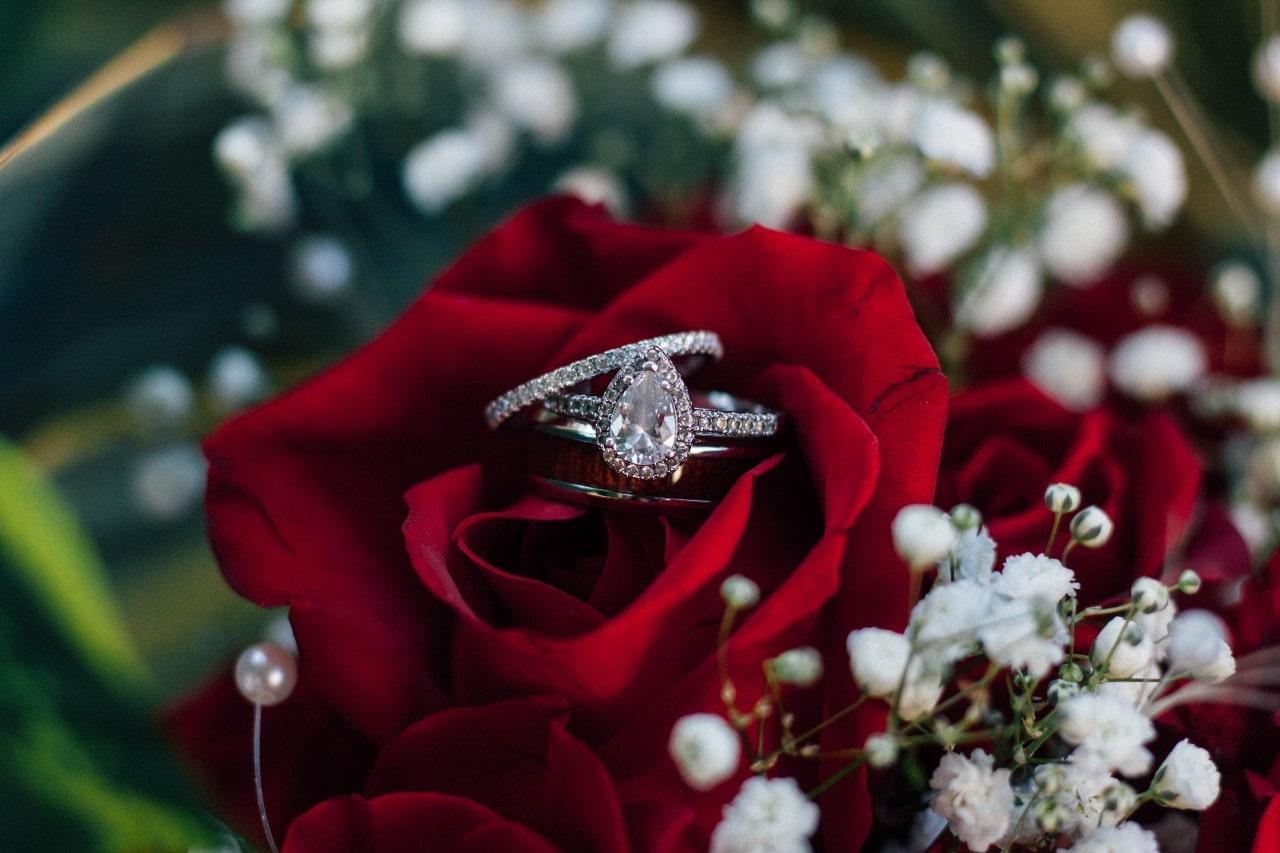
Center stone
Diamond located at the center of the engagement ring. If there are other stones in the ring, the center stone is almost always the largest and most prominent. Most typically you purchase the engagement ring setting and select the center stone. Most popular center stones include diamond, sapphire, moissanite, and colored gemstones. Center stones shapes include round, princess, oval, emerald, cushion, marquise, pear, asscher, radiant, and heart. Center stones are typically measured by carat weight and physical dimmension. The most typical carat weight for an engagement ring in the U.S. is 1.0 and 1.5 carats. The center stone weight differs from total carat weight as center stone weight will tell you what the weight of the center stone is versus all stones on the ring.
Head/Crown
The head/crown is the component that holds the main gemstone. Variations include basket head (used for a lower, protected profile), peg head (soldered for a higher profile and maximum brilliance), trellis head (interwoven prongs), tulip head (petal-shaped prongs for an organic look), low set head (for security and practicality), and high set head (to elevate the stone). The head/crown will directly dictate the stone's height, its level of protection, light exposure, and overall visual presentation.
Prong / Claws
Setting for gemstones where the jewel is held secure via small metal spikes or bars. It allows the jewel to be viewed from all angles and is, by far, the most common gemstone setting. A few common prong styles include the four prong (the most common type of prong), six prong (typically used for larger 1ct+ stones), double prongs (most popular for cusion/emerald cut diamonds), claw prongs (which feature tapered points), v-prongs (great for vulnerable corners), diamond-tipped prongs, round prongs vs. flat prongs, eagle claw prongs. Prong orientation can also be set diagonally or int he compass direction (North, South, East, West), with the latter giving a more square appearance. Note that a key trade-off with selecting the prong style is the number or width of prongs (more prongs/larger prongs for more security) can reduce the visibility of the stone, which can potentially diminish light entry. Due to the exposed nature of the prong style, prongs can require periodic maintenence and repairs. Have your prongs checked routinely for tightness and re-tip over time as they can loosen or wear down.
Gallery
The gallery is made up of the metalwork and space located directly beneath the center stone. This engagement ring part of the ring can be customized for both design and performance. This section can serve as a canvas for intricate design and details, like a modern hidden halo of diamonds tucked just beneath the main stone, or more classic embellishments like detailed filigree and scrollwork. You can add peek-a-boo or surprise stones set into the side walls for a unique touch. The design of the gallery can effect how center stone performs in achieving the ultimate brilliance, fire, and sparkle.
Bridge
The bridge is a setting where the main stone sits high held by a metal structure spanning the top of the band, often times creating a noticeable gap between the gem's base and wearer's finger. Perfect for maximizing light and sparkle for the center stone, but holds the increased risk of snagging on fabrics and potential for the ring to spin if top-heavy. A bridge can feature intricate open metalwork. Bridges provide the wearer with the opportunity for hidden details with the underside of the bridge being an ideal and discreet spo for personal engravings or the setting of a secret signature gem.
Shoulders
The upper shank part of the band that rises from the base and connects to the head, holding the main setting. It primarily serves as support for the head and contributes to the overall structural integrity of the ring. Often times the shoulder is where accent stones are placed and can feature on a variety of width variations.
Shank
This is the front-facing part of the ring that holds the center stone, as well as other details and add-ons. There are many varieties of shanks that instill a distinctive look into the piece. Shank styles include the traditional/classic highlighted by the perfectly round band which maintains a consistent width and curve around the finger. The Euro Style, which features a slightly flattend bottom edge. Perfect in preventing the ring from spinning on the finger. The Cathedral is distinguished by sides that arch gracefully upward, framing the center stone setting like the arches of a cathedral (adding height and prominence). Straight shank, which maintains a uniform width from the base all the way to the head of the ring. Tapered shank is known for its distinct narrowing as it approaches the center stone, making the mains tone appear larger. The reverse tapered widens as it gets to the center stone, giving you a more substantial and bold frame. Knife edges where the center of the band is raised to a sharp peak, or V-shape, rather than being rounded. Split shanks seperate into two or more strands as it nears the center stone. Bypass shanks have the ends of the bands not meet at the center setting but instead cross over or wrap around the main stone. Swirl shank is similar in the bypass, but the band forms a soft, continious spiral or curve leading up to the center setting. Criss-cross shank feature strands of the metal band crossing over each other multiple times. The twisted/rope shank is formed by two or more metal strands braided or twisted together. The width range of the shank typically falls between 1.5mm and 3mm or more.
Sizing Area
The sizing area (often called the sizing bar or sizing gap) is the plain, solid metal section located at the very bottom of an engagement ring's band (the shank).
Hallmark
Hallmarks are stamps inside the band indicating metal type and purity (like 14K, 18K, PT for platinum, or 925 for sterling silver).
Types of Engagement Ring Settings
Solitaire
Engagement ring that lacks accessory or accent diamonds. Typically highlighted by a single stone and praised for its classic design. With all focus on the center stone, it offers one of the most maximized light exposures. Most pick the solitaire ring for its versatility, often times more affordable price, durability and timelesness.
Halo
A layer of diamonds that surrounds the center stone. Perfect for making the center stone appear larger. The halo can be structured in various shapes from standard, to cushion, to squared. Shop our Halo Rings.
- Hidden halo: A variation wherein the center stone rests on the halo, making it exclusively visible from the side profile. Praised for its more modern aesthetic.
- Double halo: A double halo is an engagement ring setting that features two concentric, parallel rings of small accent gemstones (usually pavé diamonds) completely encircling the center stone.
Bezel
Setting for a diamond that surrounds the stone in the band’s precious metal. A metal rim encircles the stone, making it the most secure option with a sleek, modern look; available as a full bezel (complete coverage) or half bezel (partial coverage).
Three Stone
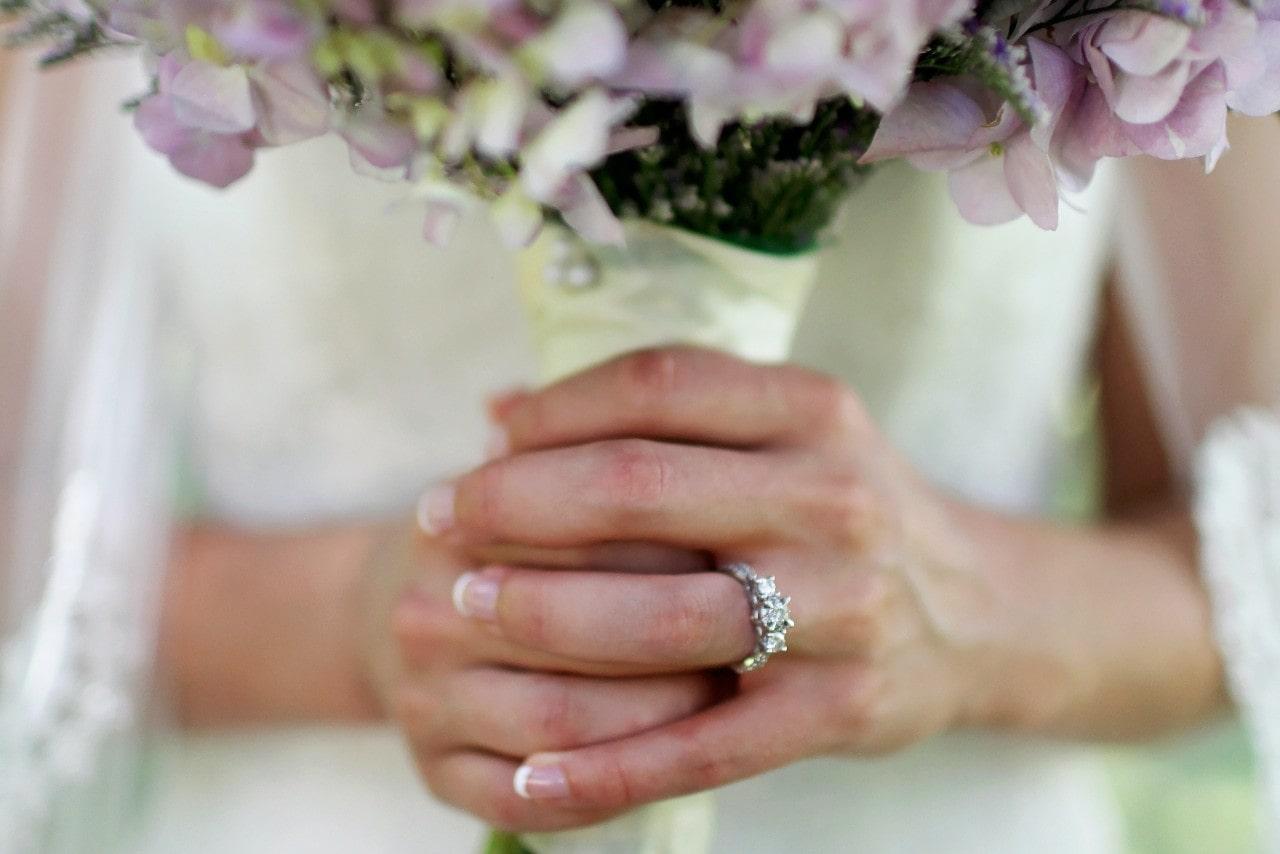
The center diamond is flanked by two accessory stones, usually other diamonds. They can be in all varieties of cuts and shapes. Options exist for matching diamonds where each diamond is cut in the same shape and complementary stone shapes where you can mix diamond shapes for a more unique look.
Pavé
Commonly used as an accent, pavé is a line of diamonds. It is named after the French word for cobblestones. There are a few varieties of pavé.
- French Pavé: Diamonds are set in v-shaped grooves cut into the band.
- Micropavé: Tiny diamond paves, usually stacked on top of each other for a spectacular display.
East-West Setting
Stone is set in a horizontal orientation, making it the best choice for elongated shapes like ovals or marquise cuts. Known for its modern, unique style.
Cathedral
An engagement ring setting that features 2 arches that slope up either side of the center stone.
Tension Setting
A modern, dramatic design where the stone is held by spring tension, allowing for maximum stone visibility as it appears to float between the metal.
Channel Setting
This setting is usually used as side accents or on wedding bands. Channels set a line of diamonds in a crease in the band, appearing as if it's between two strips of metal. A very secure choice for active lifestyles, protecting them from snags and impact
Vintage Setting
A vintage setting refers to an engagement ring designed to replicate or draw direct inspiration from the romantic, highly detailed jewelry styles of past eras. While a truly "antique" ring is over 100 years old, modern "vintage-style" settings capture that historic charm using contemporary craftsmanship.
Understanding Prongs: Types & Styles
Four Prong vs. Six Prong
When choosing between a four-prong and a six-prong setting, you are balancing visibility against security. The choice drastically changes how much metal covers your diamond and even alters the perceived shape of the stone itself.
Claw Prongs
Claw prongs taper down to a sharp, fine point rather than a rounded bead, resembling a delicate talon grasping the diamond. Because they come to such a narrow tip, they cover significantly less of the diamond’s upper surface than traditional round prongs. This minimal coverage allows more light to enter the stone while giving the ring a sleek, modern, and slightly edgy look that beautifully highlights the diamond's crisp edges.
V-Prongs
V-prongs are specialized metal brackets shaped like the letter "V." Instead of sitting on top of a diamond, they wrap completely around its sharpest corners. These are strictly used for fancy diamond shapes with vulnerable, pointed tips—such as princess, pear, and marquise cuts. Because diamond points are incredibly fragile and prone to chipping or snagging on clothing, the V-shape acts as a heavy-duty metal shield to absorb everyday impacts.
Double Prongs
Double prongs feature two slender prongs placed side-by-side at each corner or holding point, rather than a single wire. This style splits the mechanical tension between two smaller tips, which provides exceptional security for larger center stones. Visually, double prongs have a distinct, luxurious vintage charm. They look particularly stunning on emerald, cushion, and radiant cuts, as they elegantly accentuate the clipped corners of these specific shapes.
Prong Orientation Options
Prong orientation refers to the exact placement of the prongs around a diamond, and changing it completely alters the ring’s overall aesthetic. The two primary options for a four-prong setting are:
- Classic Orientation (Square): Prongs are placed at the standard "corners" (Northwest, Northeast, Southwest, Southeast). This is the traditional look that gives round diamonds a slightly squared-off structure.
- Compass Orientation (Compass Rose): Prongs are rotated to point directly North, South, East, and West. This creates a highly unique, star-like geometry that naturally draws the eye along the vertical and horizontal axes of the finger.
Shank & Band Styles Explained
Traditional vs. Euro Style
A traditional shank features a perfectly round, fluid circle of metal all the way around the finger. It is the classic, time-tested choice that offers uniform comfort and a timeless look.
A Euro style (European shank) intentionally flattens the outer bottom edge of the band, creating a subtle square shape at the base of the finger. This architectural design serves a very functional purpose: the flat edges add extra weight and leverage at the bottom, preventing top-heavy rings from spinning or flopping to the side.
Cathedral Shank
An engagement ring setting that features 2 arches that slope up either side of the center stone.
Split Shank
A split shank is when the band divides into two as it approaches the center stone, creating a more substantial and dramatic look.
Tapered & Reverse Tapered
Tapered shank is known for its distinct narrowing as it approaches the center stone, making the mains tone appear larger. The reverse tapered widens as it gets to the center stone, giving you a more substantial and bold frame.
Specialty Shank Designs
Beyond structural variations, specialty shanks incorporate unique textures, shapes, and patterns to showcase individual personality:
- Knife-Edge: The outer surface of the band is carved into a sharp, sloped ridge, creating a distinct line down the center. This ridge catches the light beautifully and makes the band look incredibly delicate and thin while retaining its structural thickness.
- Bypass: The two sides of the band do not meet evenly at the center. Instead, they twist and pass by each other on opposite sides, creating a dynamic, fluid, and swirling frame that looks like the metal is cradling the diamond.
- Twisted / Vine: The shank replicates overlapping strands of metal or diamond-cut ribbons woven together, offering a highly romantic, nature-inspired, or whimsical aesthetic.
Accent Stone Settings
Diamond Terms
Blemish: Visible flaws on a polished diamond’s surface, including scratches, abrasions, and nicks.
Branded diamond/cut: Patented cutting style, such as Hearts On Fire’s “Most Perfectly Cut Diamond.”
Brilliant cut: Diamond cut with a plethora of facets used to facilitate light reflection. The round cut is the most classic and popular.
Brilliance: Brightness and radiance emitted from a diamond’s .
Four C’s: Four diamond grading guidelines used by Gemological Institute of America
- Carat (c or ct): The weight of a gemstone, not to be confused with karats. A carat is equal to 200 milligrams.
- Clarity: Lack of internal or external flaws, sometimes called “inclusions” or “blemishes”
- Color: The absence of color in a diamond, ranges from “D” (colorless) to “Z” (yellow or brown.)
- Cut: Accuracy and precision that styles the stone into certain guidelines. The cut has less to do with the physical shape and more to do with how the facets reflect light.
Crown: The diamond’s facets around the top. Located above the girdle.
Culet: The flat bottom of a diamond where the lower facets meet. Sometimes used to give the diamond some more structure.
Eye Clean: Describes gemstones with no visible flaws. Some flaws may still be found under a magnifying glass.
Face/Table Up: When the diamond’s crown and table face towards the viewer, as in most engagement rings.
Face/Table Down: The inverse of face/table up, when the diamond’s pavilion is positioned outward.
Facet: Polished sides cut into a diamond.
Fancy Shape: Anything other than a round diamond, such as emerald, oval, or pear-shaped diamonds.
Fire: Color flashes from a polished diamond.
Flawless: Diamonds lacking any flaws, even when viewed under a magnifying glass.
Fluorescence: Light visible when viewed under ultraviolet (UV) light.
Girdle: A diamond’s outer edge, determines the silhouette.
Inclusion: Flaws inside a polished diamond, can be seen through a stone’s facets.
Kimberley Process: Certification that ensures diamonds are ethically sourced and conflict-free.
Laboratory-grown: Diamonds created in a laboratory, as compared to natural-mined.
Loupe: Magnifying glass used by gemologists.
Melee: Trade term describing tiny diamonds that weigh 0.2 carats. They are often used in side stone settings.
Pavilion: Facets below the diamond’s girdle.
Plot: A plot is a diagram that shows the clarity of a diamond. Typically found with a diamond certification, a plot diagram shows characteristics such as diamond inclusions, facet arrangements, and blemishes.
Princess Cut: Marketing and colloquial term for “square modified brilliant diamond.” It has a square shape which, when viewed from the side, resembles an inverted pyramid.
Proportions: Relationship between angles and measurements of a diamond, such as the width of a pear cut diamond.
Scintillation: The play of light and shadow in a diamond when rocked back and forth.
Shape: A diamond’s silhouette, such as those found in oval, cushion, or round cut diamonds.
Simulants: Alternative gemstones used to mimic diamonds, such as cubic zirconia.
Table: The outermost flat surface on a cut.
Diamond Setting Terms:
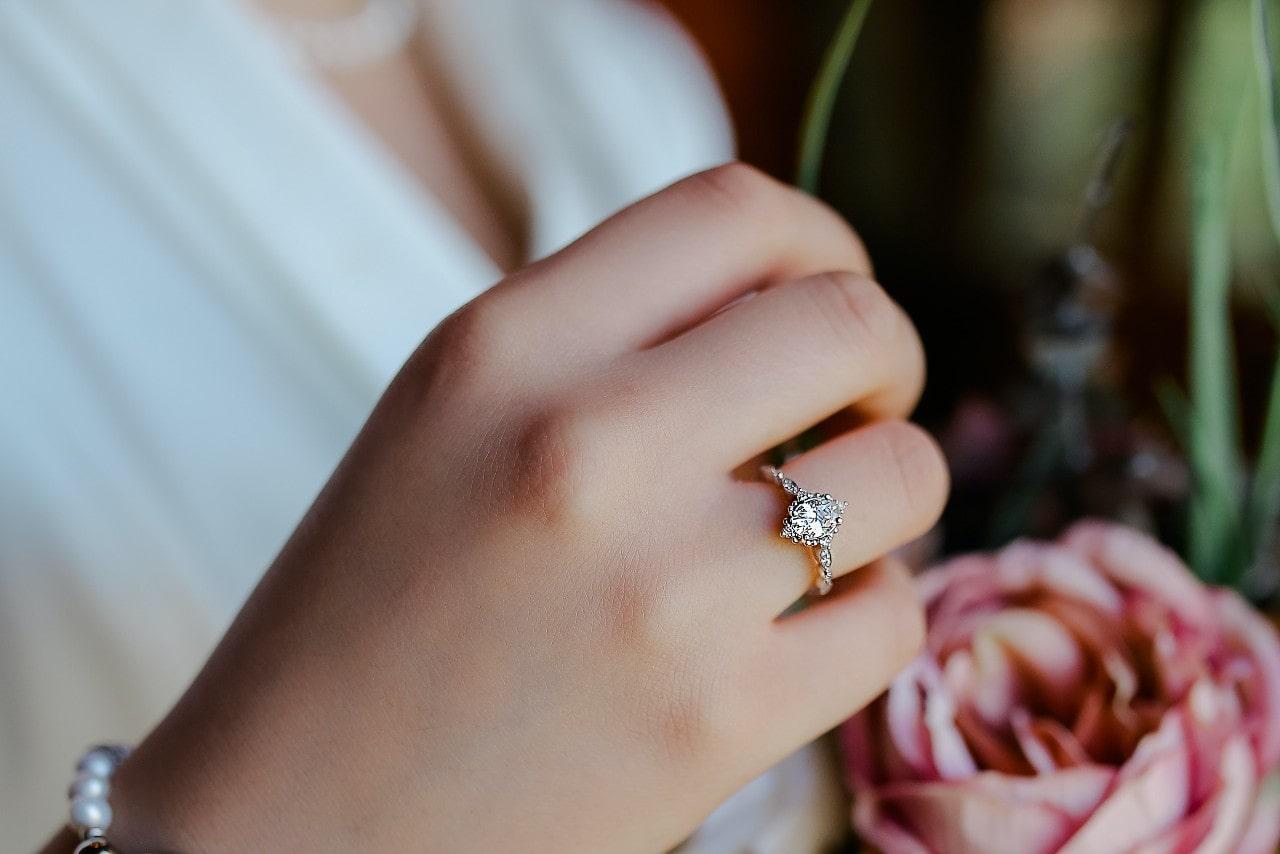
Accent stones: Small diamonds set in the band beside the center stone.
Engagement Ring Terms
Band: The precious metal circle in which the diamonds are set.
Millgrain: Tiny metal beading is used to create a more versatile silhouette, commonly used in vintage rings.
Profile: The silhouette or shape of a ring, especially when viewed from certain angles.
Setting: Refers to how the center and accessory diamonds are set or mounted in a band.
Side stone: Accent or accessory diamonds set in the shank surrounding the center stone.
Precious Metal Terms
Alloy: A material made through the combination of multiple hard metals, such as copper, silver, or gold.
Copper: While not often used by itself in modern fine jewelry, it is frequently used to strengthen other metals. Copper is hypoallergenic but tarnishes easily.
Gold: Naturally yellow, this element is the base of many precious metals used in jewelry.
- Rose Gold: Its red-pink hue comes from the use of copper in the alloy.
- White Gold: An alloy made with gold and other metals such as palladium and copper. Eventually coated with rhodium.
- Yellow Gold: While gold is inherently this color, this term separates it from other alloys.
Karat: Measurement used to describe the purity of gold. For example, 24k gold is pure. Not to be confused with carats (used for diamonds) or carrots (used for snacks). Sometimes abbreviated as kt.
Nickel: Another metal used to reinforce precious metals, nickel isn’t hypoallergenic like copper is. It can cause allergic reactions in some people.
Platinum: Among the most valuable and luxurious materials, platinum is rarely made into an alloy due to its natural strength.
Rhodium: Sometimes used to add a radiant sparkle to a piece and is frequently used in white gold. Jewelry with rhodium plating should be taken to a jeweler to be redipped, or else the gold’s natural yellow may shine through.
Sterling Silver: An alloy made with 92.5% fine silver and 7.5% other metals, especially copper. Not often used in engagement rings.
Accent Stone Settings Terms
Accent Stones vs. Side Stones
Accent stones are found along the band while side stones flankk the ccenter stone.
Channel Setting
Stones are secured inside a recessed grooved channel for high durability, making it a snag-free choice for active lifestyles that creates a clean, modern border.
Pavé vs. Micro-Pavé Setting
Small diamonds are held by miniscule beads for moderate security, best used when you want the band to look like solid diamond for a continuous surface of sparkle. Micro pave are tiny diamond paves, usually stacked on top of each other for a spectacular display.
Shared Prong Setting
One set of prongs holds two neighboring stones for low-to-moderate security, best used in eternity bands to create a wall of continuous fire with minimal visible metal.
Bezel Setting
Each stone is fully encircled by metal for excellent durability, perfect for modern, geometric styles that create a distinct "bubble" or "dotted" look along the band.
Half Bezel Setting
Metal covers only two sides of the stone for high security, offering a contemporary look that provides a balance of protection and light entry.
Bead & Bright-Cut (Pinpoint)
Stones are held by tiny metal beads within a beveled frame for high security, making it ideal for vintage designs that create an ornate, high-shine effect.
Surface Prong Setting
Individual prongs are raised above the band for moderate durability, making it a classic choice that maximizes light for a highly brilliant visual effect.
Bar Setting
Stones are secured by vertical metal bars placed between them for moderate-to-high security, best for circular or square stones to create a sophisticated, architectural aesthetic.
Gypsy/Flush Setting
Stones are sunk into holes so they sit level with the metal surface for maximum durability, making it the best choice for active wearers who want a subtle, understated shimmer.
Design Details & Embellishments
Milgrain
A decorative technique of small metal beading applied to the edges of a ring to create a vintage/antique style finish through fine edge detailing.
Filigree
Intricate metal scrollwork or wire designs used for vintage-inspired decoration on the gallery and shank, adding a lace-like texture to the ring.
Engraving
The addition of custom messages on the inside or outside of the band, achievable through the artistic depth of hand engraving or the precision of machine engraving.
Hidden Details
Hidden diamonds or gemstones set into the gallery or bridge that serve as a personal detail only visible from certain side angles.
Hammered/Textured:
Finish An artisanal, non-smooth surface created by dimpling the metal, which provides a rugged look and hides daily wear better than high-polish finishes.
Pierced/Openwork
Design elements where the metal is cut out to create negative space, resulting in a delicate appearance and a lighter, more airy ring structure.
Rope/Twisted
A textured band appearance that mimics a strand of rope to add dimension and a traditional motif to the shank of the ring.
Mixed Metal
The practice of combining different metals (such as rose and white gold) to create two-tone designs for unique, personal customization.
Side Stones Terms
Round: The most popular side stone choice, offering unmatched brilliance and a classic, symmetrical look that pairs well with virtually any center shape.
Princess: A sharp-angled square cut that provides modern, architectural lines and high sparkle; it is best paired with square or rectangular center stones like Princess or Radiant.
Emerald: A rectangular step-cut with "hall of mirrors" faceting; it offers a sophisticated, vintage feel and is most commonly used to flank Emerald or Asscher center stones.
Oval: An elongated, rounded shape that provides a soft, finger-slimming effect and adds significant surface area sparkle to the sides of the ring.
Baguette: A small, rectangular step-cut with straight parallel sides; it creates a sleek, understated frame that directs all the attention toward the center stone.
Tapered Baguette: Similar to a standard baguette but with one end narrower than the other, creating a graceful "v-shape" that follows the natural curve of the ring's band.
Bullet: A five-sided shape that looks like a baguette with a pointed "V" tip on one end; it provides a sharp, geometric transition from the center stone to the band.
Trapezoid: A four-sided shape with two parallel sides and two slanted sides, acting as a wider, more substantial version of a baguette to add "girth" to the ring's center.
Trillion: A bold, triangular shape with three equal sides; its sharp points and broad face create a dramatic, modern look that widens the visual impact of the ring.
Half Moon: Essentially an oval or round diamond cut in half, featuring one straight edge and one curved edge; it is perfect for "hugging" the curves of an Oval or Round center stone.
Crescent: A specialized, curved-edge trapezoid or half-moon variation designed specifically to nestle tightly against the rounded sides of Ovals or Marquise diamonds for a seamless fit.
Engagement Ring Terminology FAQ
- Q: What are the parts of an engagement ring called?
A: The main parts of a ring include the center stone, head/crown, prongs, gallery, bridge, shoulders, shank/band, sizing area, and hallmark. Each component plays a specific role in the ring's structure and appearance. - Q: What holds a stone in place on a ring?
A: Stones are typically held by prongs (small metal claws) or a bezel setting (metal rim). Prongs allow more light but require maintenance, while bezels offer maximum security. - Q: What is the top part of a ring called?
A: The top is called the "head" or "crown." It's the part that holds the center stone and includes the prongs or bezel. - Q: What is the part of a ring that goes around your finger?
A: This is called the "shank" or "band." It's the circular metal portion that wraps around your finger. - Q: What are the side diamonds on a ring called?
A: Small diamonds flanking the center stone are "side stones," while tiny diamonds along the band are "accent stones" or "pavé diamonds." - Q: What is a ring without a stone called?
A: A ring without a stone is simply called a "band" – like a wedding band or stacking band. - Q: What's the difference between side stones and accent stones?
A: Side stones are larger stones flanking the center stone (like in three-stone rings). Accent stones are smaller diamonds set along the band for added sparkle. - Q: What is the gallery of a ring?
A: The gallery is the space beneath the center stone, visible from the side. It can be plain or decorated with scrollwork, stones, or hidden design elements. - Q: What is a split shank?
A: A split shank is when the band divides into two as it approaches the center stone, creating a more substantial and dramatic look. - Q: What does cathedral setting mean?
A: A cathedral setting features arched sides (like cathedral architecture) that elevate and support the center stone, visible from the side profile. - Q: What is milgrain on a ring?
A: Milgrain is a decorative technique using tiny metal beads to create a detailed, vintage-inspired edge along the setting or band. - Q: What is filigree?
A: Filigree is intricate metalwork featuring delicate scrolls and swirls, commonly found on vintage-inspired ring galleries and shanks. - Q: How many prongs should an engagement ring have?
A: Most rings have 4-6 prongs. Four prongs show more of the stone, while six prongs offer more security, especially for stones over 1 carat. - Q: What is a hidden halo?
A: A hidden halo is a ring of small diamonds beneath the center stone, invisible from above but adding sparkle from side angles. - Q: What is a high profile vs. low profile ring?
A: High profile rings elevate the stone prominently above the finger. Low profile rings sit closer to the finger for a more subtle, secure design. - Q: What is the sizing area on a ring?
A: The sizing area is the bottom portion of the shank (around 5-7 o'clock position) where jewelers add or remove metal to resize the ring. - Q: What do ring hallmarks mean?
A: Hallmarks are stamps inside the band indicating metal type and purity (like 14K, 18K, PT for platinum, or 925 for sterling silver). - Q: What is a bezel setting?
A: A bezel setting uses a metal rim to completely (or partially) surround the stone, offering maximum security and a sleek, modern look. - Q: What are V-prongs?
A: V-prongs are shaped like the letter V and protect vulnerable corners on stones like princess cuts, pears, and marquise diamonds. - Q: What is an east-west setting?
A: An east-west setting places the center stone horizontally (sideways) on the band instead of vertically, creating a modern, unique look.
Putting It All Together
At The Wedding Ring Shop, you will find a boundless variety of engagement rings. Understanding the engagement ring anatomy will help in finding your dream ring. Our marvelous selection showcases many of today’s top designer brands, ensuring that every visitor finds their dream piece in our Honolulu jewelry store. We also offer diamonds perfectly suited to be the center stone that represents your romance and match our ring anatomy. At our store, we only employ the most highly skilled experts so as to guarantee that our entire inventory is of peerless quality. Contact us on our website to schedule a personalized appointment, or call us anytime at (808) 945-7766 for all the answers to any of your questions.
About the Author
Michael A. Han is the President and Founder of The Wedding Ring Shop in Honolulu, Hawai‘i. With over 40 years of fine jewelry expertise, Michael has guided the store to become one of Hawaii’s most trusted destinations for engagement rings, wedding bands, and custom diamond jewelry. His passion for craftsmanship and personalized service reflects The Wedding Ring Shop’s core values of quality, integrity, and aloha, helping every couple find a ring that tells their unique love story.
Related Articles